This essay explores how a mystical experience, its later expression through language, and an ancient principle of Advaita Vedānta came to illuminate one another.
It begins with a direct encounter with the Absolute, described in my book The Why, How, and What of Existence. It then examines how the same insight is reframed in my poem The Proof. Finally, it compares both expressions with Advaita’s teaching that consciousness and truth are self-luminous.
The underlying question is simple:
Can a philosophical truth be verified through one’s own experience rather than merely accepted as doctrine?
When we look around, we see that many people hold beliefs they have never verified. They simply cling to them because an authority, their culture, friends, family, or work environment share similar beliefs, so doing so is convenient. But it takes courage to question these beliefs and find one’s own answers through direct experience.
The method: experience before belief
The starting point is the Hermetic pursuit of gnosis: knowledge gained through direct experience rather than second-hand belief.
A teaching about ultimate reality should not be accepted merely because it appears in an ancient text or is supported by religious authority. It should become something to investigate inwardly and, as far as possible, verify for oneself. The Church sometimes places itself between people and God and then abuses that position of power. But when one finds one’s own way to God, its power diminishes.
Tradition may provide a map, but the map is not the journey. Reading a book about cooking is not the same as cooking.
The method followed here is therefore:
Experience first, expression second, philosophy last.
I did not begin with Advaita Vedānta’s principle that consciousness is self-luminous. First came a mystical experience. Then came the attempt to preserve it in language, first in my book and later in a poem. Only afterward did I recognize a close parallel in Advaita.
The sequence matters. The philosophy did not shape the experience in advance. It was encountered later and examined against something already lived.
The encounter with the Absolute
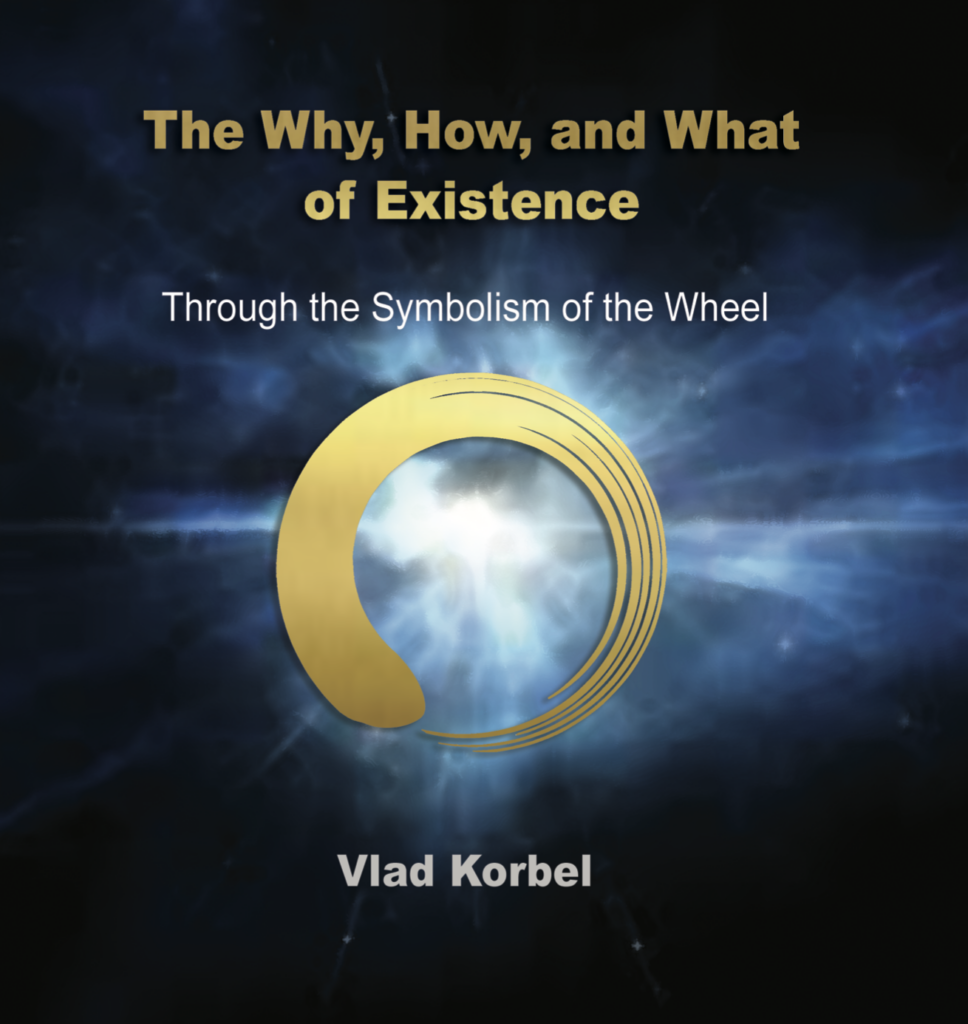
In The Why, How, and What of Existence, I describe what I understood as a direct encounter with the Absolute principle, or Godhead, underlying existence.
He, She, or It manifested as a perfectly straight ray of light:
After He’s taken me through Heaven and Hell,
He manifested Himself as a ray of light of exact straightness;I felt being one with that ray of light as if it was the only thing which truly existed;
He let me be Him for a little time, flying through space in all directions I wanted;
He shined through my mind, paused, turned around, pointed at Himself and asked:
“Who am I?”
He laughed. I laughed too, bathing in love and tears, knowing that we are one.
This was not merely a vision of light. The Light was the form in which the Absolute revealed Itself.
I did not simply observe the ray from outside. I experienced identity with it. The ray appeared to be the only thing that truly existed, while the distinction between God, the Light, and the consciousness experiencing it temporarily dissolved.
Yet language immediately restores the separation that the experience removed. The sentence “He let me be Him” still contains a “He” and a “me.” I use “He” in the passage, but the Absolute had no gender.
Grammar divides what the experience united.
The question “Who am I?” was not asking for a name. It was the Absolute turning toward Itself through my own mind. The questioner, the one hearing the question, and the reality to which it pointed were no longer separate.
The answer came not as doctrine, but as laughter, love, tears, and direct recognition:
We are one.
The experience reflected in language
The same insight later found a simpler expression in the poem The Proof, which was inspired by a dream.
The Proof
How do I know
I’m the light?
Through the reflection
Of the light that
Illuminates your eyes
When you look at me.How do you know
You’re the light?
Through the reflection
Of the light that
Illuminates my eyes
When I look at you.Now we both know
We’re the light.We both know
That we are one.If you seek a simple proof;
“Let it be the light!”
The poem begins with a question of knowledge:
How do I know I’m the light?
It does not ask how I can believe it or how I can become it. It asks how it can be known.
The answer is reflection.
I recognize the Light in myself through the Light illuminating your eyes when you look at me. You recognize it through the Light illuminating mine. Neither creates the other’s light. Each becomes a mirror through which the same Light recognizes itself.
The poem therefore moves through three stages:
I am the Light.
You are the Light.
We are one.
The final line is not merely metaphorical. The Light is both what is being recognized and that by which recognition occurs.
It is the proof and the means of proof.
Advaita and self-luminosity
Only later did I encounter the Advaita Vedānta principle of self-luminosity, svayam-prakāśa.
The idea is simple.
The sun illuminates the earth, the trees, our bodies, and everything we see. But the sun does not need another sun to reveal that it is shining.
It reveals itself through its own light.
That is what self-luminous means.
Advaita says that consciousness is self-luminous in the same sense. Every thought, perception, memory, question, and doubt is known because it appears within consciousness. Yet consciousness does not require a second consciousness to reveal it.
Even the statement “I doubt that consciousness exists” already appears within consciousness. The doubt cannot remove the awareness by which the doubt itself is known.
Reason and scripture may guide the seeker, but they do not manufacture this truth. They remove mistaken ideas that prevent us from recognizing what is already present.
Like the sun emerging when the clouds pass, truth reveals itself.
The convergence
The experience came first.
The book preserved its immediate form: the encounter with the Absolute, the ray of Light, identity with it, the question “Who am I?”, and the realization of unity. All of this later found a philosophical parallel in the principle of self-luminosity.
The poem then transformed the experience into a relational image. The one Light recognizes itself through two human beings looking at one another. It offers a simple proof of this truth through the self-luminous nature of the Light.
Finally, Advaita supplied the philosophical principle: consciousness and truth are self-luminous. They do not need something outside themselves to make them known.
This is where the Hermetic pursuit of gnosis and Advaita meet, and where self-luminosity is first experienced, then expressed, and finally conceptualized.
Hermeticism asks us not to stop at doctrine, but to seek direct knowledge. Advaita says that the deepest truth is not an external object at all. It is the consciousness through which every experience is already known.
The conclusion
A mystical experience cannot prove Advaita Vedānta to another person as a physical experiment might demonstrate a law of nature. But it can provide experiential validation for the person who independently encounters what the philosophy describes.
I did not first accept the Advaita doctrine and then interpret my experience through it.
I encountered the Absolute as Light.
I attempted to express that encounter in prose and poetry.
Only afterward did I discover a philosophical tradition whose central principle corresponded closely to what I had experienced.
This does not prove every claim made by Advaita. But it gives its central insight a validation that dogmatic belief cannot provide: recognition through one’s own consciousness.
Experience reveals.
Language reflects.
Philosophy clarifies and formalises.
And when all three converge upon the same Light, the logical conclusion is not that truth has been created by experience, poetry, or philosophy.
It is that each has disclosed something already present.
Truth is always self-luminous.
If you seek a simple proof,
let it be the Light.
Leave a Reply