
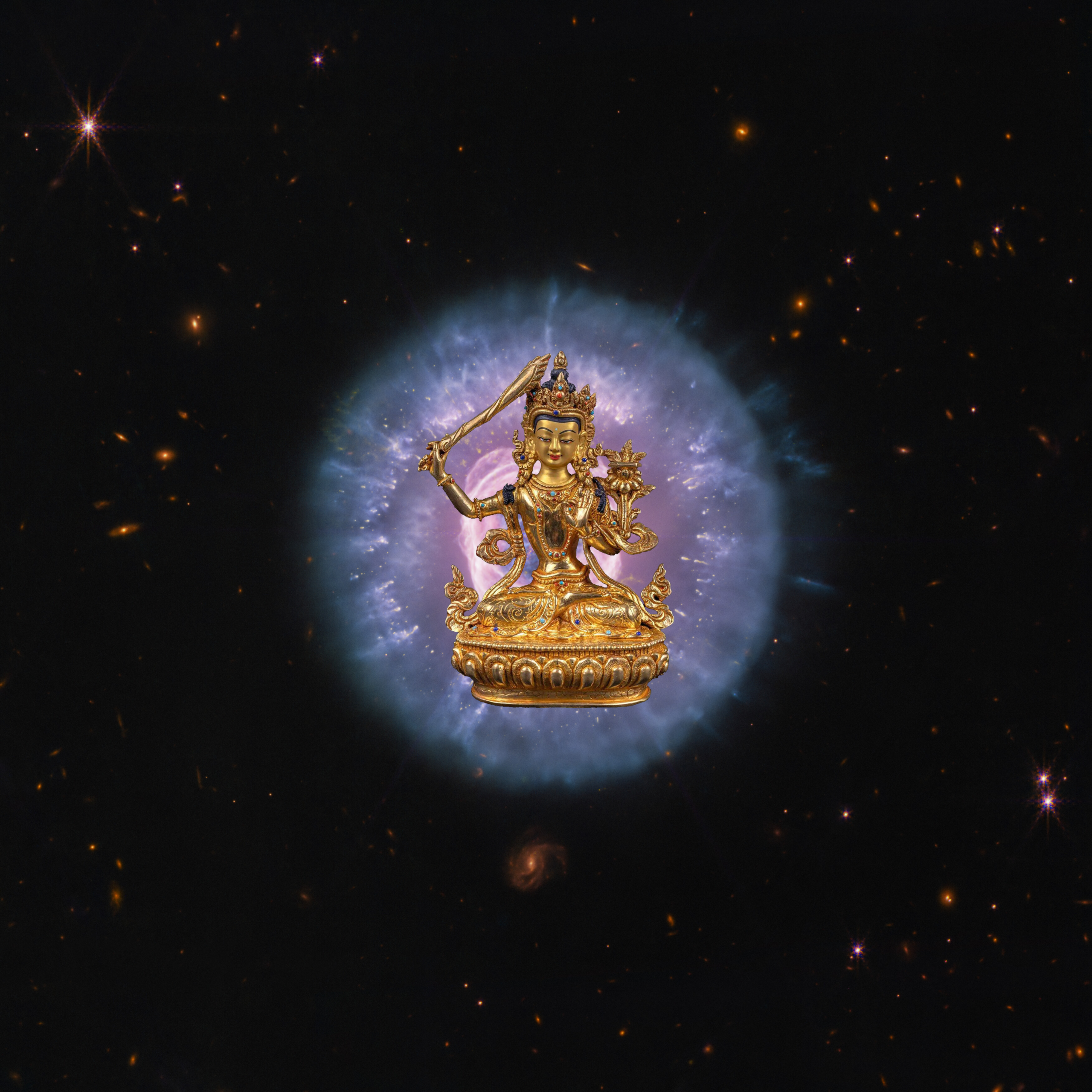
Mañjuśrī is one of the most revered bodhisattvas of Mahāyāna Buddhism and the embodiment of transcendent wisdom, or prajñā. He is traditionally depicted holding a flaming sword that cuts through ignorance and illusion, revealing the true nature of reality. In the Vimalakīrti Nirdeśa Sūtra, his wisdom brings him to the threshold where thought and language reach their limits.
A bodhisattva is a being committed to awakening, not for oneself alone, but for the liberation of all beings. In the Mahāyāna tradition, wisdom and compassion are inseparable. To see through the illusion of a separate self is also to recognize that no being is truly separate from us. The bodhisattva therefore seeks no private escape from the world, but returns to its suffering with the intention of helping others awaken.
In the Vimalakīrti Nirdeśa Sūtra, Vimalakīrti asks the bodhisattvas to explain how they understand entry into the nondual Dharma. Each approaches it through a different pair of apparent opposites.
Comfort in the Dharma begins with the most fundamental duality of birth and death. Since ultimately nothing is created and nothing is destroyed, the opposition between the two dissolves.
Guardian of the Three Virtues turns to subject and object. Wherever there is an ego, there is also something perceived as separate from it. But when no independent ego can be found, its object can no longer arise in the same way.
Highest Virtue considers impurity and purity. When the underlying nature of impurity is clearly perceived, even the idea of purity ceases to be necessary. One cannot exist without being defined against the other.
Skillful Mind speaks of saṃsāra and nirvāṇa. When the true nature of saṃsāra is understood, there is neither birth nor death, bondage nor liberation. Nirvāṇa is no longer somewhere else to which one must escape.
Treasure of Threefold Potency goes even further. Realization itself appears to require someone who realizes and something to be realized. When nothing is regarded as an object of realization, there is neither grasping nor rejecting.
These answers approach nonduality through philosophy and contemplation, but they still rely on distinctions in order to transcend them.
Vimalakīrti then asks Mañjuśrī how a bodhisattva enters the nondual Dharma.
Mañjuśrī answers: “In my opinion, when all things are no longer within the province of either word or speech, and of either indication or knowledge, and are beyond questions and answers, this is initiation into the non-dual Dharma.”
Mañjuśrī understands that nonduality cannot be captured by language. Yet he still uses words to explain why words are insufficient.
Mañjuśrī therefore turns to Vimalakīrti:
“All of us have spoken; please tell us what is the Bodhisattva’s initiation into the non-dual Dharma.”
Vimalakīrti kept silent without saying a word. At that, Mañjuśrī exclaimed: “Excellent, excellent! Can there be true initiation into the non-dual Dharma until words and speech are no longer written or spoken?”
Vimalakīrti simply remains silent.
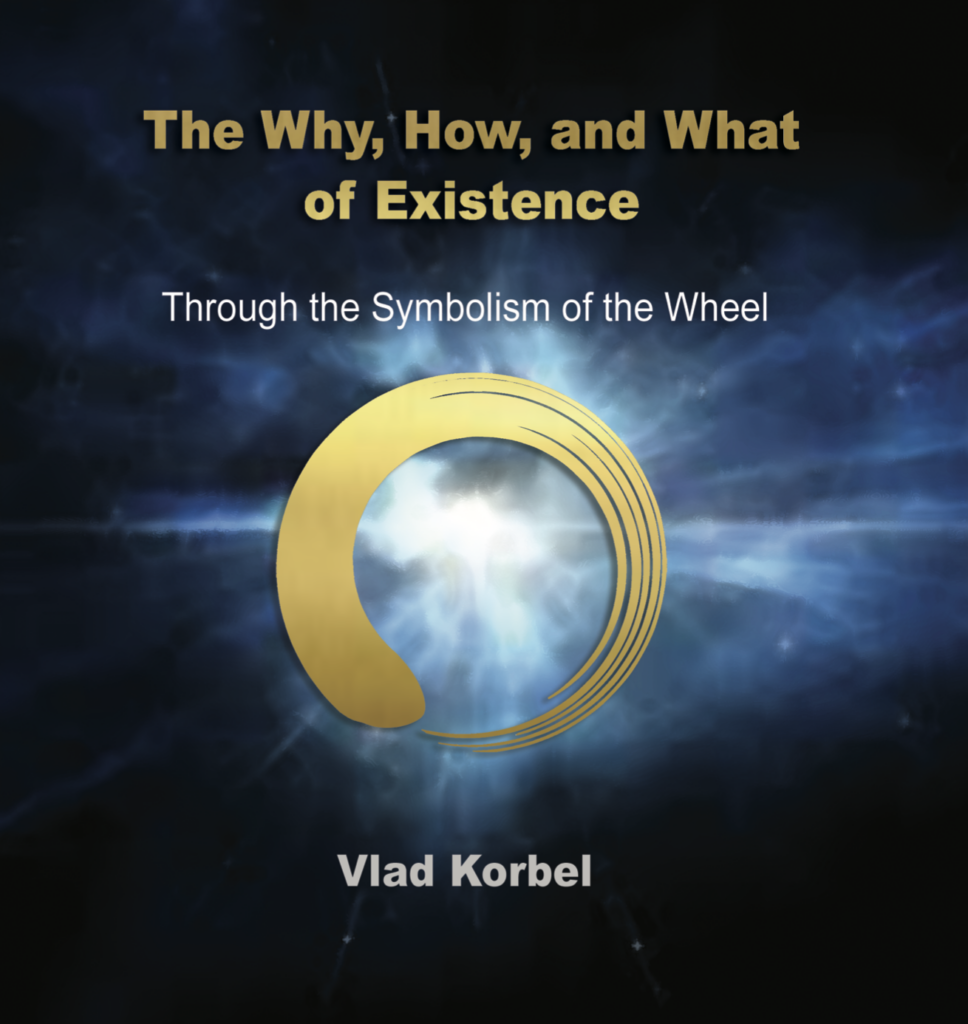
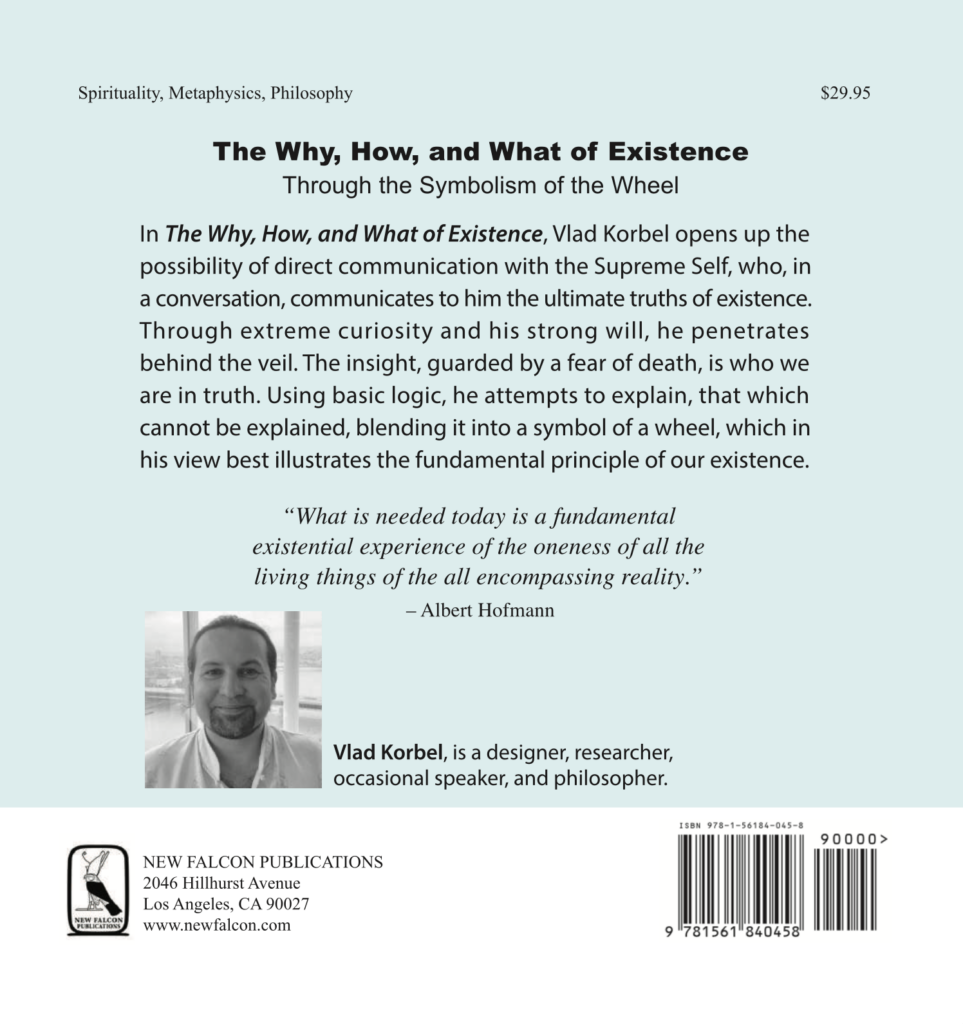
I approach a similar threshold in my book, The Why, How, and What of Existence, which emerged from several journeys of inquiry to the Supreme Mind or Supreme Self.
The Why begins with a question about humanity and our world. The answer I received was Love, not merely as an emotion, but as the only principle worth following and the force that reveals our connection within one consciousness. I call it “the glue of existence.”
The How is a guide towards oneness. Drawing on the wisdom of Hermes Trismegistus in To Asclepius, it asks us to expand beyond the limitations of the separate self in order to apprehend the divine. The Absolute is present in everything. You are That, too.
The What turns towards the question “Who am I?” It draws upon the self-inquiry of Sri Ramana Maharshi and Neti Neti, “not this, not that,” found in the Upaniṣads and advocated by Adi Śaṅkara.
I am not my identity, body, possessions, experiences, desires or even the mind that constructs the idea of who I am. What remains is existence, consciousness and bliss. The no-one, yet the Absolute.
The inquiry culminated when the Supreme Self appeared as a ray of light. I became one with that light. He then pointed towards Himself and asked:
“Who am I?”
He laughed. I laughed too, bathing in love and tears, knowing that we are one.
This is where Vimalakīrti’s silence resonates with me most deeply. The bodhisattvas reveal some of the many forms through which duality appears. The Why, How and What offers a path towards its dissolution. But no explanation can replace realization itself.
Words may lead us to the threshold.
Silence passes through it.
And so do love and laughter.
It is the ecstasy beyond words, where Nothing reveals itself as Everything.
If you seek a simple proof,
let it be the light.
Leave a Reply